Solutions
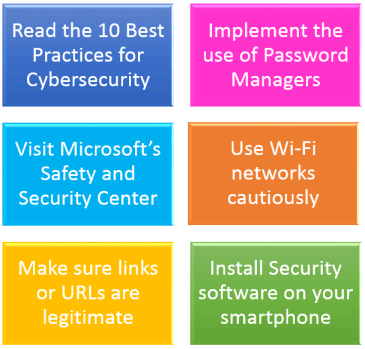
- Read the 10 Best Practices for CyberSecurity
- Implement the use of Password Managers, visit http://lifehacker.com/5042616/five-best-password-managers
- Visit Microsoft’s Safety and Security Center https://www.microsoft.com/security/pc-security/password-checker.aspx
- Use Wi-Fi networks cautiously. Use VPN or SSL protection. Do not send sensitive data such as mobile banking through public Wi-Fi and Bluetooth. Turn off Bluetooth when not in use.
- Make sure links or URLs are legitimate – only go to trusted sources
- Install security software on your smartphone http://www.avast.com/en-us/free-mobile-security
SOLUTIONS
Note: Number nine pertains to Mobile Device protection, and a strong password is the best tip. For more information http://www.healthit.gov/providers-professionals/cybersecurity
- Use Strong Passwords and Change Them Regularly – Visit Microsoft Safety and Security Center to see if your password is strong enough: https://www.microsoft.com/security/pc-security/password-checker.aspx
- Install and Maintain Anti-Virus Software
- Use a Firewall
- Control Access to Protected Health Information
- Control Physical Access
- Limit Network Access
- Plan for the Unexpected
- Maintain Good Computer Habits
- Protect Mobile Devices
- Establish a Security Culture
Protect Mobile Devices
Mobile devices—laptop computers, handhelds, smart phones, and portable storage media— have opened a world of opportunities to un-tether EHRs from the desktop. But these opportunities also present threats to information security and privacy. Some of these threats overlap those of the desktop world, but others are unique to mobile devices.
- Because of their mobility, these devices are easy to lose and vulnerable to theft.
- Mobile devices are more likely than stationary ones to be exposed to electro-magnetic interference (EMI), especially from other medical devices, such as MRI machines. This interference can corrupt the information stored on a mobile device.
- Because mobile devices may be used in places where the device can be seen by others, extra care must be taken by the user to prevent unauthorized viewing of the PHI displayed on a laptop or handheld device.
- Not all mobile devices are equipped with strong authentication and access controls. Extra steps may be necessary to secure mobile devices from unauthorized use. Laptops should have password protection that conforms to that described in Practice 1 . Many handheld devices can be configured with password protection and this should be enabled when available. Additional steps must be taken to protect PHI on the handheld, including extra precaution over the physical control of the device, if password protection is not provided.
- Laptop computers and handheld devices are often used to transmit and receive data wirelessly. These wireless communications must be protected from intrusion (Practice 6 describes wireless network protection). PHI transmitted unencrypted across public networks (e.g. the Internet, public Wi-Fi services) can be done where the patient requests it and has been informed of the potential risks. Generally, however, PHI should not be transmitted without encryption across these public networks.
Transporting data with mobile devices is inherently risky. There must be an overriding justification for this practice that rises above mere convenience. If healthcare data is stored on the mobile device, ensure that encryption is installed and enabled. The newest iPhone models have achieved FIPS 140-2 certification for their encryption modules. Mobile devices that cannot support encryption should not be used. This includes the inexpensive memory sticks or thumb drives that are widely available and often given away by vendors. Encrypted versions of these devices are readily obtainable at a modest cost—much less than the cost of mitigating a data breach. Remember to encrypt the removable media like the microSD card in your phone.
If it is absolutely necessary to take a laptop out of a secure area when the laptop contains patient data, the laptop’s hard drive should be encrypted. Encryption for laptops has become so affordable, and so easy to install and manage, it is hard to envision a reason that all laptops are not encrypted today. To leave a laptop unencrypted is to invite unnecessary risk to your organization and to ignore the benefits such as safe harbor from federal and state data breach laws.
Policies specifying the circumstances under which devices may be removed from the facility are very important and all due care must be taken in developing and enforcing these. The primary goal is to protect the patient’s information, so considerations of convenience or custom (e.g. working from home) must be considered in that light.
But I need to work at home today…
In today’s increasingly mobile world, it is certainly tempting to use mobile technology to break away from the office and perform work from the comfort of home, a travel hub, or a coffee shop. Those who have responsibility for protecting patient data must recognize that this responsibility does not end at the office door. Good security practices must always be followed.
Sponsored by: RISC Management, www.RISCsecurity.com
Contact us today for all your compliance needs: Sales@RISCsecurity.com
References
About.com. (2014). What makes a smartphone smart? Retrieved from http://cellphones.about.com/od/smartphonebasics/a/what_is_smart.htm
Bloomberg Business Week. (2013). How Samsung became the world’s no. 1 smartphone maker. Retrieved from http://www.businessweek.com/articles/2013-03-28/how-samsung-became-the-worlds-no-dot-1-smartphone-maker
HealthIT.gov.(2014). CyberSecurity: 10 Best practices for the small health care environment. Retrieved from http://www.healthit.gov/providers-professionals/cybersecurity
Hill, M. (2010). 5 Terrifying ways your own gadgets can be used to spy on you. Retrieved from http://www.cracked.com/article_18532_5-terrifying-ways-your-own-gadgets-can-be-used-to-spy-you.html
Home Box Office, Inc. (2014). The Wire. Retrieved from http://www.hbo.com/the-wire#/
Microsoft. (2014). Safety and security center: Create strong passwords. Retrieved from https://www.microsoft.com/security/pc-security/password-checker.aspx
Tech Media Network. (2014). Top Ten Reviews: 2014 Best smartphone reviews and comparisons. Retrieved from http://cell-phones.toptenreviews.com/smartphones/
U.S. Department of Health & Human Services. (2014). Health Information Privacy: Guidance materials for consumers. Retrieved from http://www.hhs.gov/ocr/privacy/hipaa/understanding/consumers/index.html
U.S. Department of Justice. (2013). Privacy and civil liberties: Electronic Communications Privacy Act of 1986. Retrieved from https://it.ojp.gov/default.aspx?area=privacy&page=1285

 RISC Management and Consulting
You must be logged in to post a comment.